
More than 90 percent of american businesses using Google Ads struggle to see a clear return on their investment. Setting clear objectives and allocating your budget wisely can make the difference between wasted spend and meaningful growth. By following a focused, step-by-step approach, you can create campaigns that reach the right audience, deliver impactful messaging, and drive real results for your business.
Table of Contents
- Step 1: Define Your Campaign Objectives And Budget
- Step 2: Set Up Audience Targeting And Ad Structure
- Step 3: Create Compelling Ad Copy With Strong CTAs
- Step 4: Optimize Bidding And Keyword Selections
- Step 5: Track Conversions And Measure Campaign Performance
Quick Summary
| Effective Insights | Clear Explanation |
|---|---|
| 1. Set Clear Objectives and Budget | Begin your campaign by defining measurable goals and allocating resources wisely to maximize effectiveness. |
| 2. Target the Right Audience | Utilize advanced targeting techniques to reach specific customer segments, enhancing the relevance of your ads. |
| 3. Craft Compelling Ad Copy | Write focused ad content that aligns with user intent and clearly communicates benefits to encourage clicks. |
| 4. Optimize Keywords and Bidding | Develop a diverse keyword strategy and employ data-driven bidding techniques to enhance campaign performance. |
| 5. Track Conversions Effectively | Implement robust tracking to measure key actions and understand customer journeys for better optimization. |
Step 1: Define your campaign objectives and budget
Successful Google Ads campaigns start with crystal clear objectives and strategic budget allocation. This crucial first step determines whether your advertising efforts will generate meaningful results or burn through resources without impact.
Defining your campaign objectives requires precision and strategic thinking. Performance marketing strategies suggest identifying specific, measurable goals like increasing website traffic, generating leads, or driving direct sales. Your objectives will directly influence your campaign structure, targeting, and budget decisions. For instance, a lead generation campaign might prioritize conversion tracking and allocate budget towards high intent keywords, while a brand awareness campaign could focus on broader reach and impressions.
Calculating your budget demands careful analysis. Based on research from Equinet Academy, determine your daily budget by multiplying your target average cost per click (CPC) by the number of clicks you want to receive daily. Google Ads allows flexibility here, potentially spending up to double your daily budget on high-traffic days while ensuring your monthly spend remains consistent. A practical approach is to start conservative start with a modest budget of $10$20 daily, closely monitor performance, and incrementally adjust based on actual results. Pro tip: Always reserve 10$15% of your budget for testing and optimization to refine your campaign’s effectiveness.
Next, you will select the most appropriate campaign type to align with your specific objectives and budget constraints.
Step 2: Set up audience targeting and ad structure
Building a high-performing Google Ads campaign requires strategic audience targeting and a well-crafted ad structure that connects directly with your ideal customers. This step will transform your advertising approach from generic broadcast to precision marketing.
Audience targeting allows you to zero in on potential customers with remarkable specificity. Advanced ad targeting techniques enable you to create custom audience segments based on detailed characteristics like interests, online behaviors, and demographic information. Search Engine Journal highlights the power of custom affinity audiences, which let you define targeting parameters using specific interests and website URLs. This means you can create highly nuanced audience groups that align precisely with your product or service.
When structuring your ads, focus on creating a hierarchical campaign architecture that supports granular control. Start by organizing campaigns around specific themes or business objectives, then break these down into ad groups with tightly related keywords. This approach allows for more precise budget allocation and performance tracking. For each ad group, develop multiple ad variations to test different messaging approaches, ensuring you have sufficient data to optimize performance. Pro tip: Aim for at least three ad variations per ad group, which allows Google’s machine learning algorithms to identify and prioritize the most effective messaging.

Next, you will develop compelling ad copy that resonates with your precisely targeted audience segments.
Step 3: Create compelling ad copy with strong CTAs
Crafting ad copy that captures attention and drives action is the critical bridge between your audience targeting and actual conversions. Your words must be strategic, concise, and laser focused on motivating potential customers to click.
Role of ad copy in lead generation demands meticulous attention to language and structure. Google’s guidance emphasizes aligning ad text precisely with your chosen keywords while creating a compelling narrative that speaks directly to user intent. This means developing ad copy that not only matches search queries but also addresses specific customer pain points or desires. Your headlines should be direct and benefit driven, using active language that creates a sense of urgency or excitement. Include specific value propositions that differentiate your offering like exact pricing, unique features, or time limited promotions.
When constructing your call to action, think beyond generic phrases like click here. Instead, create action oriented statements that clearly communicate the benefit of taking the next step. Use powerful verbs that create momentum such as get started, claim your free quote, or unlock your discount. Pro tip: Test multiple variations of your call to action to identify which resonates most strongly with your target audience. Ensure each ad variation speaks to a slightly different emotional trigger or customer motivation, allowing you to gather data on what truly compels your potential customers to act.
Next, you will set up conversion tracking to measure the real impact of your carefully crafted ad copy.
Step 4: Optimize bidding and keyword selections
Keyword selection and bidding strategies are the financial backbone of your Google Ads campaign. Mastering these elements will determine whether your advertising budget generates substantial returns or gets lost in digital noise.
Google Ads auction mechanics require a sophisticated approach to keyword optimization. Cutting edge research suggests utilizing advanced algorithmic techniques that transform keyword selection from guesswork into a data driven science. Recent academic studies have demonstrated powerful optimization strategies using multi armed bandit frameworks that dynamically adjust bidding based on real time performance signals. This means selecting keywords isnt just about relevance but about understanding complex interaction patterns between search terms, user intent, and conversion potential.
When developing your keyword strategy, focus on creating a diverse portfolio that balances high volume terms with long tail specific phrases. Pro tip: Allocate approximately 70% of your budget to proven high performance keywords and reserve 30% for experimental terms that might unlock unexpected audience segments. Continuously monitor your keyword performance using granular metrics like click through rate, conversion rate, and cost per acquisition. This approach allows you to progressively refine your selections, eliminating underperforming keywords while scaling those demonstrating consistent results. Advanced advertisers often use machine learning techniques to predict keyword performance, analyzing subtle contextual signals that traditional approaches might miss.
Next, you will implement conversion tracking to validate the effectiveness of your keyword and bidding strategies.
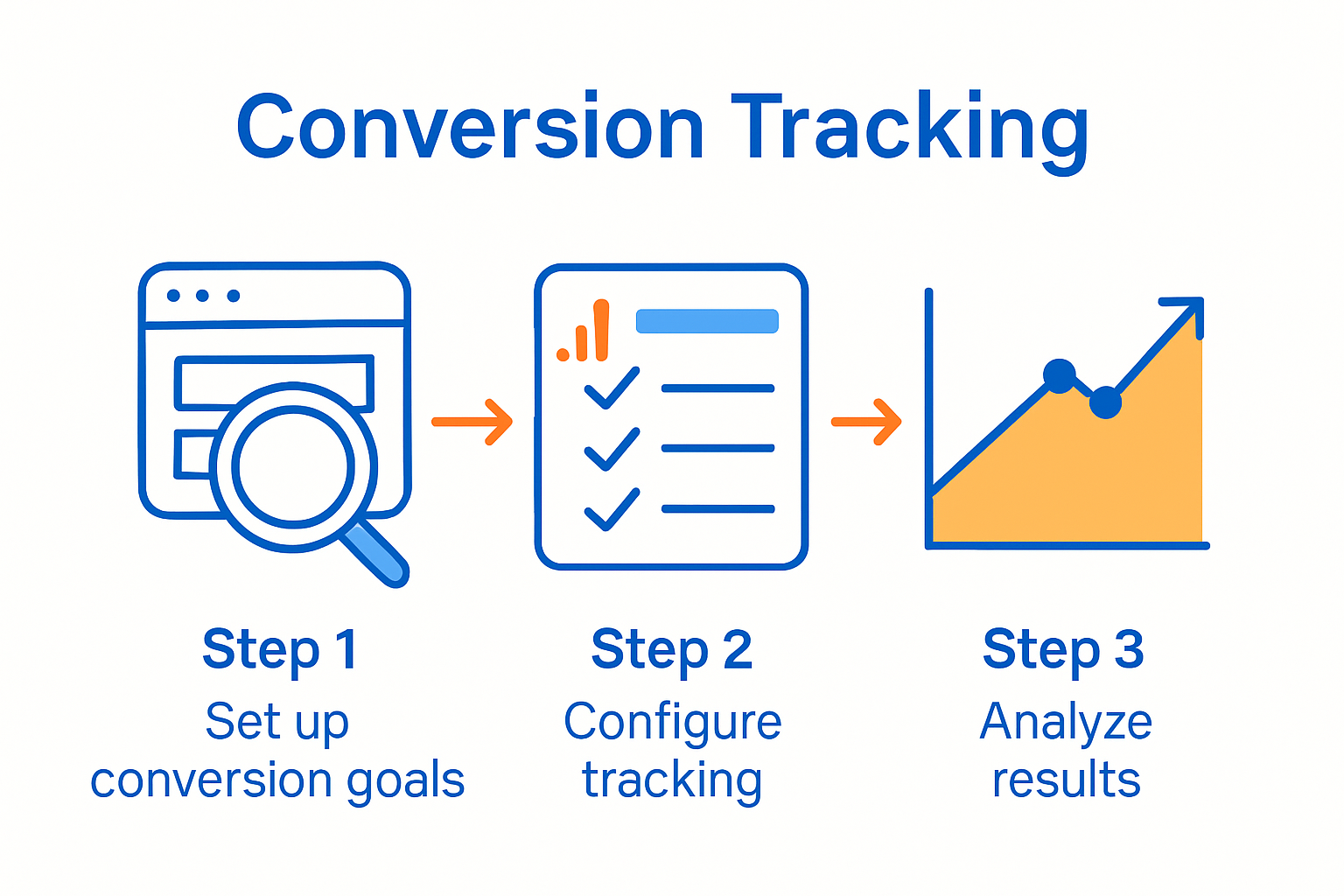
Step 5: Track conversions and measure campaign performance
Tracking conversions transforms your Google Ads campaign from a guessing game into a precision instrument for business growth. Understanding how to measure performance will unlock the true potential of your advertising investment.
Conversion rate tracking requires strategic implementation of comprehensive measurement techniques. Cutting edge research suggests developing automated monitoring systems that go beyond simple click tracking. Advanced frameworks allow advertisers to create modular performance tracking mechanisms that capture nuanced conversion signals across multiple touchpoints. This means looking beyond basic metrics and understanding the intricate customer journey from initial ad interaction to final purchase.
Establish a robust conversion tracking system by identifying your most critical business objectives. Configure Google Ads conversion tracking to monitor key actions like form submissions, phone calls, online purchases, or website sign ups. Pro tip: Assign monetary values to different conversion types to calculate precise return on investment. Use Google Analytics alongside Google Ads to gain deeper insights into user behavior, tracking metrics such as time on site, pages per session, and bounce rates. By implementing multi channel tracking, you can understand how different marketing efforts interact and contribute to your overall business goals. Advanced advertisers often use sophisticated attribution models that distribute credit across various touchpoints, providing a more holistic view of campaign performance.
Next, you will analyze your tracked data to make informed optimization decisions.
Unlock High-ROI Success with Expert Google Ads Management
Struggling to translate your Google Ads knowledge into campaigns that truly deliver results? This guide highlights key challenges like defining clear objectives, mastering audience targeting, and optimizing bids—tasks that can overwhelm busy business owners seeking real growth. At Click Thrive Marketing, we understand these pain points and specialize in transforming complex strategies into streamlined action plans that maximize your return on investment.
Whether you need precise audience segmentation, compelling ad copy, or data-driven conversion tracking, our team has managed over $30 million in Google Ads spend with proven success in lead generation and campaign optimization. Discover how our tailored services can help you avoid costly mistakes and accelerate your digital advertising outcomes by visiting our Uncategorized Archives – Click Thrive Marketing for detailed insights and updates.
Take control of your Google Ads campaign today with expert guidance. Visit Click Thrive Marketing to explore customized solutions that grow your business faster. Ready to boost your conversions and ROI? Start your journey now with our professional Google Ads management and lead generation strategies that make every dollar count.
Frequently Asked Questions
How do I define clear objectives for my Google Ads campaign?
To define clear objectives, identify specific and measurable goals such as increasing website traffic, generating leads, or driving sales. Start by determining what success looks like within 30 days and use that to guide your campaign structure and budget allocation.
What should I consider when calculating my Google Ads budget?
When calculating your budget, multiply your target average cost per click by the number of desired clicks per day. Begin with a modest daily budget of $10-$20 and reserve 10-15% for testing and optimization throughout the campaign.
How can I effectively target my audience in Google Ads?
To effectively target your audience, create custom segments based on their interests, behaviors, and demographics. Use advanced targeting techniques, such as custom affinity audiences, to hone in on potential customers whose profiles closely match your product or service.
What makes compelling ad copy for Google Ads?
Compelling ad copy should align closely with chosen keywords and address user intent directly. Focus on creating direct, benefit-driven headlines paired with strong call-to-action phrases like “Get started today” to encourage clicks.
How can I optimize my keyword selection and bidding strategies?
To optimize keyword selection, build a balanced portfolio of high-performing keywords and long-tail phrases. Allocate about 70% of your budget to proven keywords and 30% to explore experimental terms, adjusting based on real-time performance metrics.
How do I track conversions to measure campaign performance?
To track conversions effectively, implement a robust system that captures key actions such as form submissions or online purchases. Assign monetary values to these actions to calculate ROI accurately, and use tracking tools to gain insights into user behavior across different channels.
Recommended
- Google Ads Auction Explained: Complete Guide for SMBs – Click Thrive Marketing
- 7 Real Examples of Google Ads Campaigns for Business Growth – Click Thrive Marketing
- 7 Google Ads Best Practices Every Local Business Needs – Click Thrive Marketing
- Why Invest in Google Ads: Complete Expert Guide – Click Thrive Marketing
- Maximera ROI med Google Ads 2024 – iMarketing
25 Responses