
Over 90 percent of american businesses measure their success online using conversion rate, yet many still struggle to turn website clicks into real results. With each visitor representing a new opportunity, understanding what drives someone to take action can make a major difference for any brand. This guide helps demystify conversion rate essentials so you can improve performance and create stronger connections with your audience.
Table of Contents
- Defining Conversion Rate And Core Concepts
- Common Types Of Conversion Actions Online
- How Conversion Rate Is Calculated And Tracked
- Key Factors Impacting Conversion Rate Success
- Mistakes That Lower Conversion Rates And How To Avoid
Key Takeaways
| Point | Details |
|---|---|
| Understanding Conversion Rates | Conversion rates measure the percentage of visitors completing desired actions, reflecting the effectiveness of marketing strategies. |
| Types of Online Conversions | Recognize the difference between micro-conversions and macro-conversions to optimize engagement and track meaningful business outcomes. |
| Key Factors for Success | Focus on user experience, clear messaging, and trust signals to enhance conversion rates and minimize friction in user journeys. |
| Avoid Common Mistakes | Eliminate tracking inaccuracies and simplify website navigation to maintain higher conversion performance effectively. |
Defining Conversion Rate and Core Concepts
A conversion rate represents the percentage of website visitors who complete a specific desired action, transforming from passive browsers into active participants. According to GeekSforGeeks, this critical metric measures the effectiveness of marketing efforts by tracking how many people take meaningful steps toward your business goals.
At its core, conversion rate calculates the ratio between total visitors and those who perform an intended action. These actions vary widely depending on business objectives – they could include making a purchase, signing up for a newsletter, downloading a resource, scheduling a consultation, or completing an online form. Coursera emphasizes that this metric serves as a fundamental indicator of marketing campaign success, providing insights into how well your digital strategies resonate with potential customers.
Understanding conversion rates goes beyond simple mathematics. It represents a nuanced evaluation of user experience, marketing messaging, and website design effectiveness. Successful marketers recognize that improving conversion rates requires continuous testing, analyzing user behavior, and refining strategies to create more compelling user journeys. By learning about our conversion rate improvement process, businesses can develop targeted approaches that transform casual website visitors into committed customers.
Key aspects of conversion rate include:
- Measuring precise user engagement
- Identifying potential friction points in customer journeys
- Quantifying marketing campaign performance
- Providing actionable insights for optimization
- Connecting marketing efforts directly to business outcomes

Common Types of Conversion Actions Online
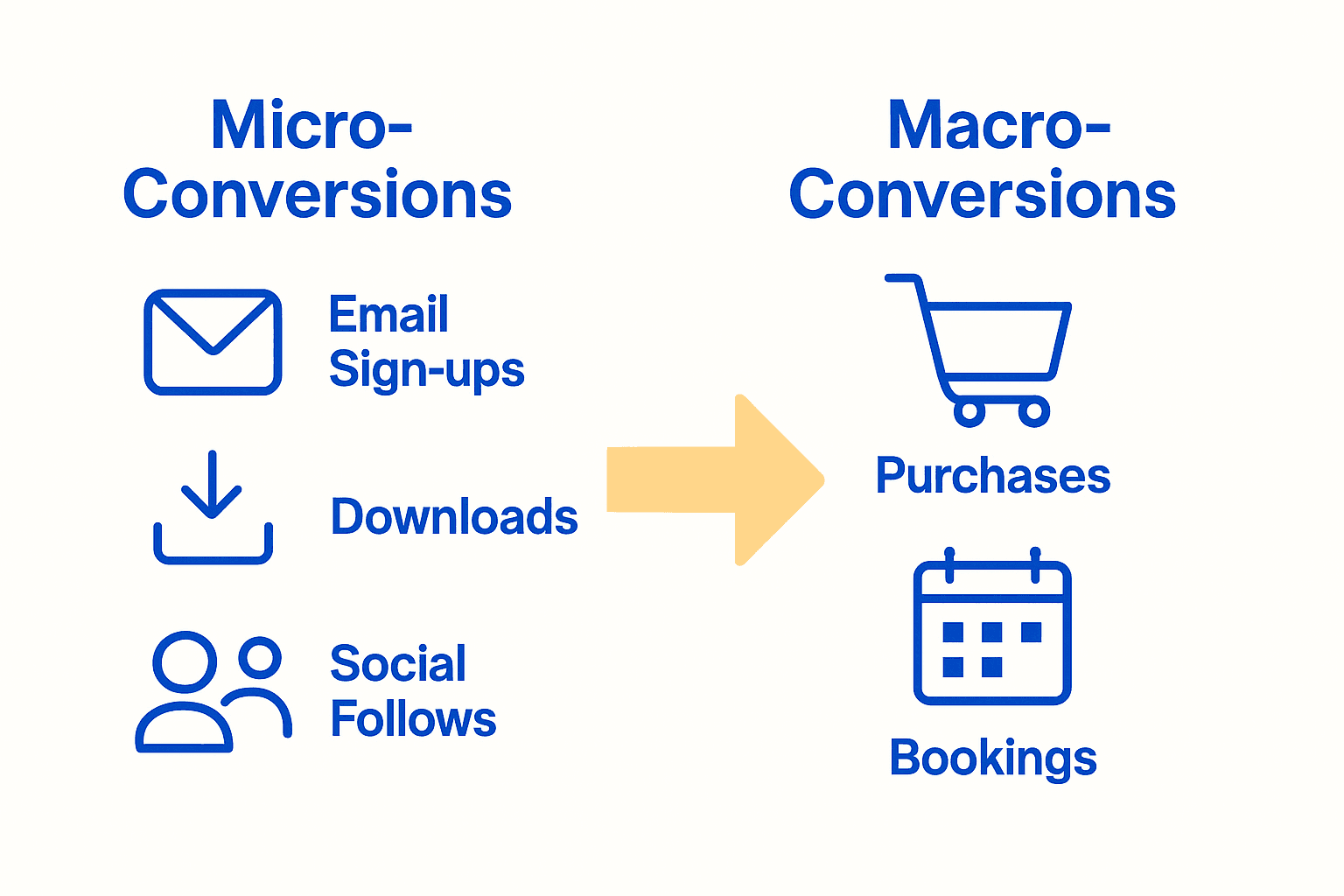
Online conversion actions represent the diverse ways potential customers interact with digital platforms, transforming casual browsing into meaningful business engagement. MetricHQ categorizes these actions into two primary types: micro-conversions and macro-conversions, which play crucial roles in tracking user progression through the customer journey.
Micro-conversions are smaller, incremental actions that signal initial user interest. According to CLRN, these typically include activities like newsletter sign-ups, content downloads, video views, following social media accounts, and adding items to a shopping cart. These interactions provide valuable insights into user engagement and potential future conversions. Macro-conversions, by contrast, represent significant business outcomes such as completed product purchases, service bookings, consultation requests, or submitted contact forms.
Successful digital marketing strategies recognize that not all conversions carry equal weight. Explore our guide on conversion rate optimization tips for small businesses to understand how different conversion types can be strategically tracked and improved. Different industries and business models will prioritize specific conversion actions based on their unique goals and customer interaction models.
Common online conversion actions include:
- E-commerce product purchases
- Lead generation form submissions
- Newsletter and email list sign-ups
- Free trial or demo requests
- Consultation booking
- Content download requests
- Phone call inquiries
- Live chat engagements
- Webinar registrations
- Free resource downloads
How Conversion Rate Is Calculated and Tracked
Calculating conversion rate is a straightforward yet powerful process that provides critical insights into marketing performance. SKRB explains the standard formula as the number of conversions divided by total visitors, then multiplied by 100 to generate a percentage. This simple calculation allows businesses to quantify the effectiveness of their digital marketing efforts and user experience strategies.
According to GeekSforGeeks, tracking conversions involves more than just basic mathematics. Multiple factors influence conversion rates, including user experience design, call-to-action effectiveness, website performance, and the clarity of marketing messaging. Modern analytics platforms like Google Analytics provide comprehensive tools for tracking conversions across different channels, enabling businesses to monitor performance and identify areas for improvement.
Explore our guide on tracking ad performance to understand how advanced tracking techniques can help businesses optimize their conversion strategies. Successful conversion tracking requires setting clear goals, implementing robust analytics tools, and continuously analyzing user behavior to refine marketing approaches.
Key steps in conversion rate calculation and tracking include:
- Defining specific conversion goals
- Installing analytics tracking pixels
- Setting up conversion tracking in marketing platforms
- Monitoring conversion paths and user journeys
- Analyzing drop-off points in the conversion funnel
- Comparing conversion rates across different marketing channels
- Implementing A/B testing to improve conversion performance
Key Factors Impacting Conversion Rate Success
Conversion rate success depends on a complex interplay of strategic elements that guide potential customers through their decision-making journey. GeekSforGeeks identifies critical factors that significantly influence conversion performance, highlighting the importance of creating a seamless and compelling user experience.
According to Coursera, user interface and user experience design play pivotal roles in driving conversions. This involves crafting intuitive website layouts, ensuring mobile responsiveness, creating clear and compelling call-to-action buttons, and minimizing friction points in the customer journey. Trust signals such as customer testimonials, security badges, and transparent pricing become crucial in transforming visitor interest into actual conversions.
Learn how to generate leads for small businesses online and discover how targeted strategies can dramatically improve conversion rates. Successful conversion optimization requires a holistic approach that considers multiple interconnected elements, from initial user engagement to final purchase decision.
Key factors impacting conversion rate success include:
- Website loading speed and performance
- Clear and compelling messaging
- Mobile responsiveness
- Intuitive navigation
- Strong value proposition
- Effective call-to-action design
- Trust and credibility elements
- Streamlined checkout or signup processes
- Personalization and targeted content
- Minimal form fields and reduced friction
Mistakes That Lower Conversion Rates and How to Avoid
Conversion rate optimization requires a strategic approach to identifying and eliminating common performance barriers. MetricHQ highlights critical tracking mistakes that can significantly undermine marketing efforts, emphasizing the importance of precise data collection and analysis strategies.
According to SKRB, one of the most prevalent mistakes is focusing exclusively on conversion rates without considering broader contextual metrics. This narrow perspective can lead to misguided marketing decisions that fail to capture the full complexity of user behavior. Common conversion rate pitfalls include tracking too many conversion events, neglecting attribution windows, and failing to validate data accuracy.
Explore our guide on ad copy in lead generation to understand how strategic messaging can help avoid conversion rate mistakes. Successful marketers recognize that reducing friction, creating clear value propositions, and implementing comprehensive tracking mechanisms are essential to maintaining high conversion performance.
Key mistakes that lower conversion rates include:
- Overcomplicated website navigation
- Slow page loading speeds
- Lack of mobile responsiveness
- Unclear call-to-action messaging
- Excessive form fields
- Poor website design and user experience
- Inconsistent brand messaging
- Weak value proposition
- Missing trust signals
- Inadequate performance tracking
Unlock Higher Conversion Rates with Expert Google Ads Management
Understanding conversion rates reveals the vital challenge of turning website visitors into loyal customers. If you struggle with slow page speeds, unclear calls to action, or complicated user journeys, you are not alone. The key pain points highlighted in the article like tracking correct conversions and optimizing user experience require focused strategies that go beyond guesswork. At Click Thrive Marketing, we specialize in addressing these exact challenges by combining data-driven insights with proven digital marketing expertise to enhance your conversion rate through targeted Google Ads campaigns and lead generation.
Boost your marketing performance with strategies designed specifically for small to medium-sized businesses. Our clients have seen measurable growth by improving search visibility, streamlining customer engagement, and removing barriers that lower conversions. Discover how our award-winning approach to conversion rate improvement process can turn your website into a high-converting asset.
Ready to overcome common conversion pitfalls and maximize your advertising ROI? Visit Click Thrive Marketing today to learn how our tailored Google Ads management and lead generation solutions help businesses thrive. Don’t wait to transform your traffic into loyal customers and steady sales. Explore proven methods to generate leads for small businesses online and start elevating your conversion rates now.
Frequently Asked Questions
What is conversion rate in digital marketing?
A conversion rate in digital marketing is the percentage of visitors who complete a desired action, such as making a purchase, signing up for a newsletter, or requesting a consultation. It helps measure the effectiveness of marketing efforts.
How do you calculate the conversion rate?
The conversion rate is calculated by dividing the number of conversions by the total number of visitors, then multiplying by 100 to express it as a percentage.
What are the different types of conversion actions?
Conversion actions can be categorized into micro-conversions, which are smaller actions like newsletter sign-ups and content downloads, and macro-conversions, which involve more significant actions like completed purchases or service bookings.
What factors can impact the success of conversion rates?
Key factors that can impact conversion rates include website loading speed, user interface design, mobile responsiveness, clear messaging, effective call-to-action buttons, and the presence of trust signals like customer testimonials.
Recommended
- Conversion Rate Improvement Process for Higher Online ROI – Click Thrive Marketing
- Digital Marketing Terminology Explained: Complete Guide – Click Thrive Marketing
- Performance Marketing Explained: Key Concepts and Strategies – Click Thrive Marketing
- How to Generate Leads for Small Businesses Online – Click Thrive Marketing